Approaching zero carbon | Wei Wendong: How to create new growth points for green and low-carbon industries
[Editor’s note]
To achieve the goal of "double carbon", parks and enterprises, as important carriers of industry, need to explore the path of sustainable development. In 2023, The Paper launched the "Approaching Zero Carbon" project, which will visit parks and enterprises to deeply investigate the green transformation of the industry. Look forward to Industry-University-Research’s mutual aid and explore practical solutions for a zero-carbon future.
Poster design Yu Fei In recent years, the public’s perception of extreme weather, natural disasters and other climate crises has become increasingly strong, and coping with climate change has become a global consensus. As Wei Wendong, an associate professor at the School of Environmental Science and Engineering of Shanghai Jiaotong University, said, coping with climate change is an inter-generational governance problem, and promoting comprehensive economic and social transformation to achieve the goal of "carbon neutrality" is an important measure to slow down climate change.In addition to the public, we need to think about how to realize the goal of peak carbon dioxide emissions and carbon neutrality (hereinafter referred to as "double carbon") from green to "low carbon" or even "zero carbon" at the production end of enterprises. However, there is still a dilemma between green development and economic benefits, which has become an important reason for the lack of motivation for local governments and enterprises to transform. How to achieve the "coordinated promotion of carbon reduction, pollution reduction, green expansion and growth" put forward by the Party’s Report to the 20th CPC National Congress is in urgent need of practical ways to break the situation.
Wei Wendong believes that while ensuring stable economic and social development and promoting green and low-carbon transformation, we need to consider developing and expanding green and low-carbon industries. He noted that at present, China has a strong global competitive advantage in photovoltaic, energy storage, new energy vehicles and other fields. Relevant industries and enterprises should be encouraged to seize the opportunity of green and low-carbon transformation at home and abroad and occupy a more important position in the global industrial chain, innovation chain and value chain. Wei Wendong also said that the key to achieving the goal of "double carbon" lies in scientific and technological innovation and building a better governance system.
The Paper: Under what domestic and international background was the concept of green and low carbon born? What important progress has China made in this regard?
Wei Wendong: Since 1980s and 1990s, some meteorologists and atmospheric scientists have noticed that the earth’s surface temperature changes began to appear abnormal. Now many studies show that since the industrial revolution, a large number of human activities, especially fossil energy consumption, have become the main cause of climate change. Among them, carbon dioxide, which accounts for about 80% of greenhouse gases, has the greatest impact.
In fact, climate change is a cross-generational governance problem. We must consider the future sustainability of the earth, strive to reduce greenhouse gas emissions such as carbon dioxide, and adapt to the impact of climate change on nature and people, and achieving "carbon neutrality" is a very important governance goal to deal with climate change.
For China, the goal of "double carbon" in 2020 is a very important node. Under the goal of "double carbon", the whole economic and social system, including production and lifestyle, will be completely transformed. As far as the industry is concerned, "double carbon" also means development opportunities.
The Paper: How can industries with different carbon emissions achieve green and low-carbon development? What aspects should we think about saving energy and reducing carbon?
Wei Wendong: First of all, for carbon-intensive industries, we should gradually change from "high carbon" to "low carbon", and we can transform the high-carbon industrial process in terms of technology and management, and transform the high-carbon emission process into low carbon through energy saving and carbon reduction. In terms of technology, for example, steel production can change from long process to short process, from blast furnace steelmaking to electric furnace steelmaking, and improve the scrap recycling network and circular economy system. In terms of process flow and management flow, there is also room for improving energy efficiency, such as matching supply and demand through digital means to improve the level of energy efficiency utilization.
Secondly, for industries that must use fossil energy and can’t avoid carbon emissions, we can build a new low-carbon and clean energy system through zero-carbon and negative-carbon technologies, such as comprehensive utilization of photovoltaic, wind power and energy storage, realizing zero-carbon power supply and developing renewable synthetic fuels.
In fact, whether it is a zero-carbon park or a zero-carbon factory, it mainly plays a pilot demonstration and promotion role at present. Only by taking the first step through the pilot can the technical cost be gradually reduced. China’s vast market and demand, as well as policy support and subsidies, are conducive to promoting the development of pilot demonstration projects and reducing the R&D costs and risks of enterprises. In the different tracks of green and low-carbon industries, it is still inconclusive which technical route will eventually stand out. It is necessary to have a diversified layout, encourage a hundred flowers to blossom and give all kinds of technologies room for development. Taking the shale gas revolution in the United States as an example, this disruptive technological breakthrough has completely changed the global energy supply and demand pattern.
The Paper: Where does the motivation for practicing green and low carbon come from? How to achieve green and low-carbon transformation while giving consideration to economic benefits and industrial development?
Wei Wendong: The reason why China wants to achieve the goal of "double carbon" is to reflect the responsibility of a big country on the one hand, and to meet the needs of domestic economic and social transformation and development on the other.
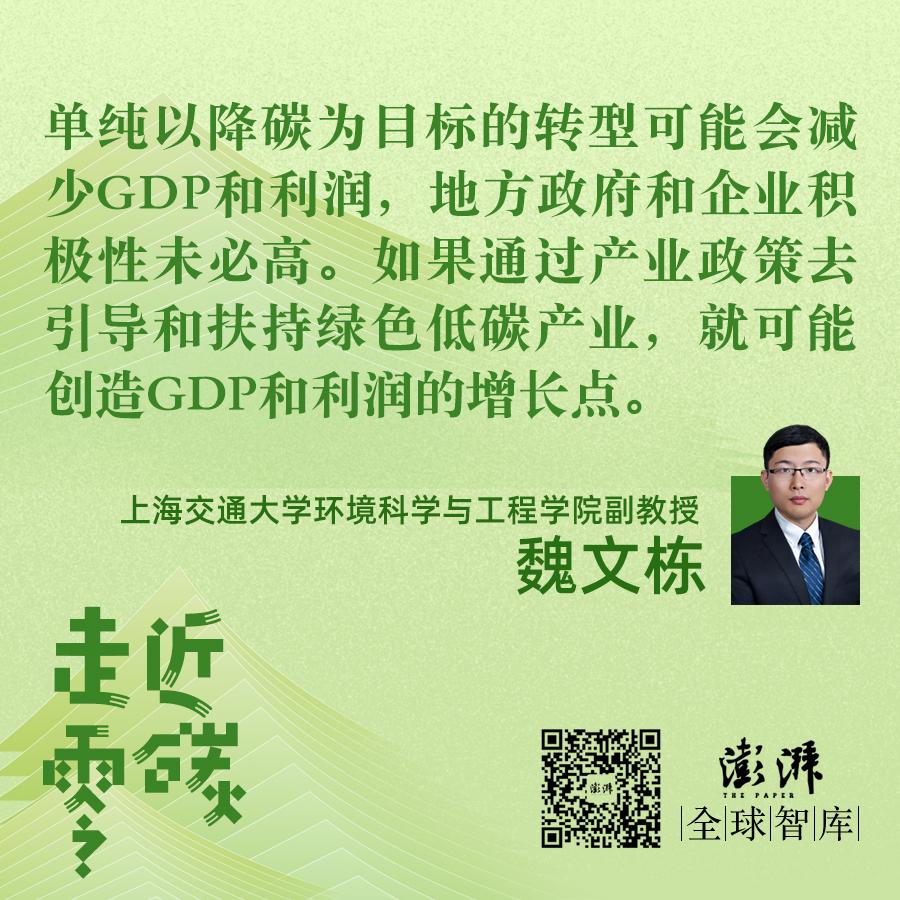
I believe that in the process of promoting the goal of "double carbon", we should not only ensure steady economic growth, but also develop green and low-carbon industries in the transformation of "changing cages for birds". Because the transformation simply aimed at reducing carbon may reduce GDP and profits, the enthusiasm of local governments and enterprises may not be high. However, if we guide and support the development of green and low-carbon industries through industrial policies, it may create the growth point of GDP and profits, and it will also bring the power to practice green and low-carbon development.
For example, at the Economic Work Conference of Shanghai Municipal Committee in 2021, it was put forward that "the green and low-carbon track should be deployed quickly", and in 2022, the Action Plan of Shanghai aiming at the new track to promote the development of green and low-carbon industries (2022-2025) was issued, which made a clear plan for the development of green and low-carbon industries in Shanghai. In addition, Ningde, Fujian and Qujing, Yunnan have also taken the lead in developing green and low-carbon industries, driving local economic growth.
In order to realize green and low-carbon transformation and give consideration to both economic benefits and green transformation, the core is that enterprises must first incorporate "green and low-carbon" into important performance indicators of production and operation. Only by taking "green and low carbon" as the business goal first, and at what stage do you need to lay out the investment, is a comprehensive trade-off problem. Because the path of green and low-carbon development in various industries is relatively clear now, it is necessary for enterprises to first turn "double carbon" into their own goals. For example, some foreign trade enterprises are sensitive to the EU’s "carbon tariff", and they will realize that green and low carbon have an impact on their production and operation, and consider incorporating carbon emissions into their business objectives.
The Paper: What are the opportunities and problems in the development of green and low-carbon industries? How to solve it?
Wei Wendong: The development of green and low-carbon industries is related to industrial characteristics and market demand. From a global perspective, China already has strong global competitive advantages in photovoltaic, energy storage, new energy vehicles and other fields. It can be said that in the process of human response to climate change, we have achieved the first transformation in some fields, seized the new opportunities of green and low-carbon industries, and pushed "Made in China" and "Made in China" to the world.
However, the green and low-carbon industrial chain is long. When investing and developing this industry, all localities need to decide according to their own production factors, and consider the regional differentiation of industries to avoid vicious competition and over-investment around the development of green and low-carbon industries among regions. Therefore, the development of green and low-carbon industries also needs top-level design and overall planning at the central level.
The Paper: From green to zero carbon, what problems need to be solved in essence? Any good suggestions?
Wei Wendong: To achieve the goal of "double carbon", scientific and technological innovation is fundamentally needed. According to the current technical level, the cost of achieving "carbon neutrality" is very high. Only through subversive technological breakthroughs and industrial revolution can the cost of carbon reduction be reduced, the green and low-carbon transformation be promoted, and the impact on economic development will be relatively small. Therefore, I think we should strengthen the cooperation of Industry-University-Research Community, promote the innovation of business model through scientific and technological innovation, and finally promote the all-round economic and social transformation to achieve the goal of "double carbon" and sustainable development.
In addition to technology, we must better build a governance system from the government and market levels. From a domestic perspective, on the one hand, it is necessary to further improve the level of governance so that the public can have a clear understanding of the goal of "double carbon". On the other hand, we should give full play to the role of the market and enterprises in the process of steady progress, and promote carbon governance through market-based emission reduction mechanisms. From an external perspective, it is very important to deal with climate change with a more inclusive governance system. Studies have shown that developing countries may be more affected by climate change due to insufficient economic and industrial development. China needs to assume the responsibility of a big country, gradually participate in leading global climate governance, and support developing countries to jointly cope with global climate change and achieve the goal of sustainable development.
(This article is from The Paper, please download the "The Paper" APP for more original information)
Reporting/feedback