The Central Meteorological Observatory continued to issue a yellow typhoon warning at 06: 00 on October 4.
CCTV News:According to the website of the Central Meteorological Observatory, the Central Meteorological Observatory continued to issue a yellow typhoon warning at 6: 00 on October 4. Typhoon KOINU, the 14th typhoon this year, was weakened from a super typhoon to a strong typhoon last night (3rd). At 5 o’clock this morning, its center is located on the northwest Pacific Ocean about 325 kilometers east of Guluanbi in Taiwan Province, China, which is 22.0 degrees north latitude and 124.0 degrees east longitude. The maximum wind force near the center is 15 (48m/s), and the center.
It is estimated that "Little Dog" will move to the west-north direction at a speed of 10-15km/h, and gradually approach the southern coast of Taiwan Province Island, with little change in intensity. It will land or brush the southern coast of Taiwan Province Island (strong typhoon level, 42-48m/s, 14-15) from the early morning of 5th, and then move to the west direction, and the intensity will gradually weaken.
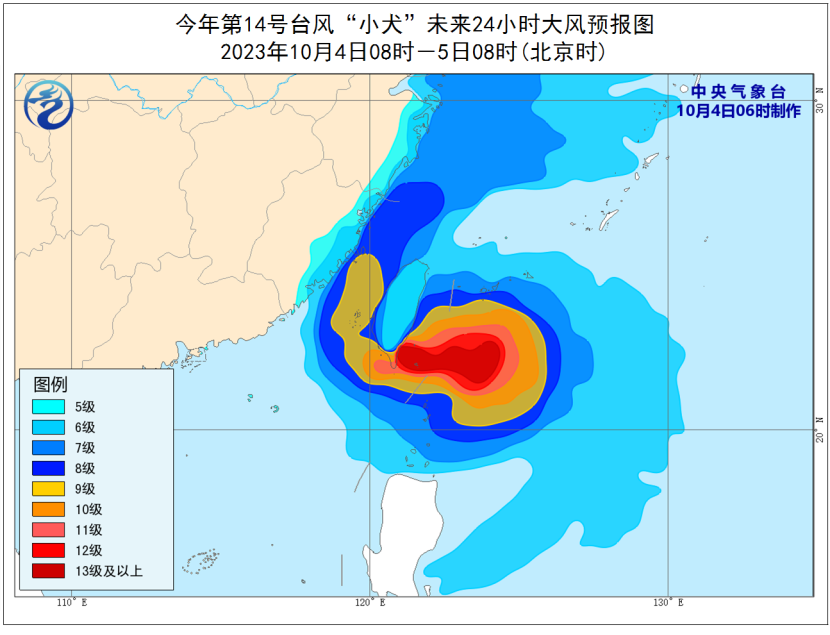
Gale forecast:From 08: 00 on the 4th to 08: 00 on the 5th, there will be strong winds of 6-8 grades and gusts of 9-10 grades in the western East China Sea and the waters near Diaoyu Island, east of Taiwan Province, bashi channel, Taiwan Province Strait, northeastern South China Sea and the coastal areas of Zhejiang, Fujian and Taiwan Province Island. Among them, the winds in the southeastern part of Taiwan Province Island, the northern part of bashi channel and parts of Taiwan Province Strait will be 9-12 grades and gusts will be 13-14 grades.
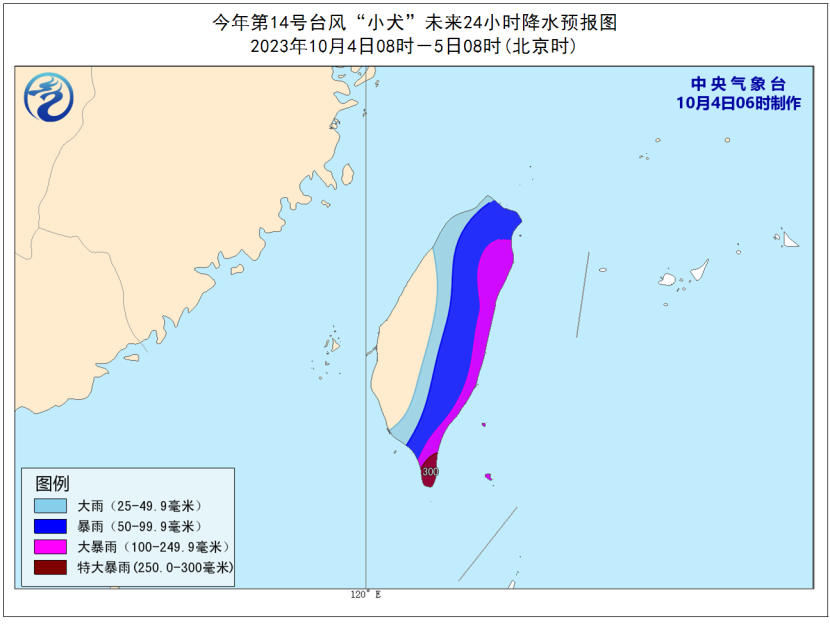
Precipitation forecast:From 08: 00 on the 4th to 08: 00 on the 5th, there was heavy rain to heavy rain in the central and eastern part of Taiwan Province Island, with local heavy rain (250-300mm).
Defense guide:
1. The government and relevant departments shall, in accordance with their duties, do a good job in typhoon prevention and emergency rescue.
2. Water operations and passing ships in relevant waters should return to Hong Kong to take shelter from the wind, strengthen port facilities, and prevent ships from anchoring, grounding and collision.
3. Stop large-scale indoor and outdoor gatherings and dangerous outdoor operations such as high altitude.
4. Reinforce or dismantle structures that are easy to be blown by the wind. Personnel should not go out at will. They should stay in windproof and safe places as far as possible, so as to ensure that the elderly and children stay in the safest place at home, and the dangerous people will be transferred in time. When the typhoon center passes by, the wind will decrease or stay still for a period of time. Remember that the strong wind will suddenly blow and you should continue to stay in a safe place to avoid the wind.
5. Relevant areas should pay attention to prevent flash floods and geological disasters that may be caused by heavy precipitation.