Whether the popularity of the 24.9-billion-pixel Shanghai Bund map involves leaking privacy is controversial.
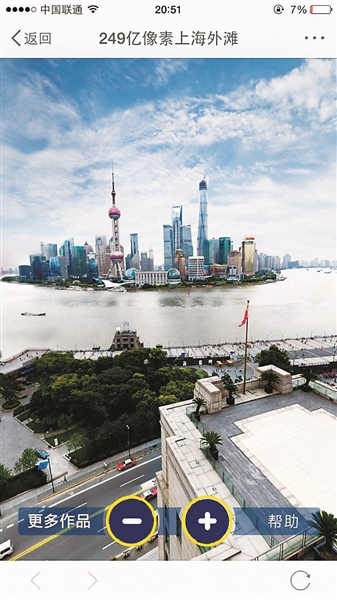
Recently, a panoramic view named "29.4 billion pixels Shanghai Bund" has been widely spread on the Internet, which can provide a panoramic view of both distant high-rise buildings and people’s subtle behaviors. According to the producer, the picture is made up of more than 2,000 photos, and then the high-definition presentation of 29.4 billion pixels is realized through related technologies and algorithms. Some netizens pointed out that the picture may infringe on personal privacy, and legal persons told the Beijing Youth Daily reporter that publishers should make necessary review of photos when publishing high-definition photos.
24.9 billion pixel map accurate to license plate number
When you open this picture, you can see the other side of Huangpu River from Shanghai Bund. Viewers can slide the screen of mobile phone up and down, left and right or move the computer mouse to watch the scene around the Bund. After enlarging the picture, we can clearly see the windows of the farthest building on the Bund, even the license plate numbers of cars driving on the road, as well as the various States of the citizens: tourists taking pictures along the Huangpu River, a couple taking wedding photos, a grandfather standing by the river with pants, and even a naked man sitting by the window of a hotel on the phone.
However, many careful netizens found that there are many scenes in the picture that are distorted, such as people are transparent, some people "lack arms and legs", and one person appears twice within one meter.
The reporter of Beiqing Daily found that the map appeared on the online forum as early as 2014 and attracted the attention of many netizens. The company that sent this picture is a company named "Shanghai Jingkun Technology".
On the company’s official website, the reporter of Beiqing Daily saw this panoramic picture of "29.4 billion pixels of Shanghai Bund", in addition, it also listed "195 billion pixels of Shanghai Super Panorama" and "31.2 billion pixels of Shenzhen" and other similar pictures.
More than 2000 photos are spliced together.
Li Huamin, the person in charge of Shanghai Jingkun Technology Co., Ltd. told Beiqing Daily that the panorama of "29.4 billion pixels Shanghai Bund" was made in 2014, which was spliced by more than 2,000 photos taken by professional cameras, and then through the technology and algorithm independently developed by the company, the picture was finally presented in high definition with 29.4 billion pixels.
Li Huamin said that the size of the spliced picture is about 200 g. "It is impossible for ordinary mobile phones and computers to open, so we cut it into millions of small units, put it together through algorithms and upload it to the cloud." When the user moves and enlarges the picture on the mobile phone or computer, the background will push the corresponding image according to the user’s action, and present it to the user after loading.
What is the concept of 24.9 billion pixels? Li Huamin said that the pixels of a normal SLR camera are between 20 million and 30 million pixels, while the human retina has about 534 million pixels. "If you look at the Bund in the same position, you can see what the naked eye can’t see on the picture, which is better than your feeling of being there."
Regarding the distorted picture pointed out by netizens, Li Huamin explained that these 2,000 photos were taken by matrix photography. "There is a time difference when taking pictures. For example, when this person is walking, the first photo only captures the upper body, and when the second photo is taken, the person walks away. These two photos are not a complete person, so this is what is presented." "This picture is an experimental thing and has not been handled very well.
Does high-definition graphics invade privacy?
After the panorama of "29.4 billion pixels Shanghai Bund" became popular on the Internet, some netizens said that they could see all kinds of life from the picture, but many netizens pointed out the personal privacy issues involved.
From this panoramic view, people can easily see such a scene, such as the grandfather carrying pants by the river, the naked man talking on the phone by the hotel window and the people standing in the room chatting. Some netizens said that although it was unintentional, such high-definition pictures would expose people’s privacy.
Li Huamin said frankly that he didn’t think about privacy when he made this picture. "I have consulted professionals. We took a picture in an open environment, not with it, so there is no legal problem."
Han Xiao, a lawyer of Beijing Jingrun Law Firm, said that when publishing high-definition photos, publishers should make necessary review of the photos and fulfill their duty of care, such as mosaicing those who expose privacy. "In foreign countries, privacy is also an important right. The Google Street View service launched in 2007 was fined or banned in many countries because it violated public privacy. "
Text/reporter Huang Xiaojing